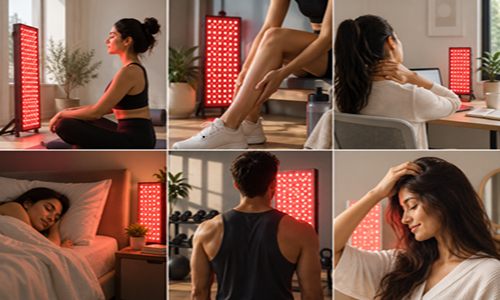
Introduction: Recovery Is Just as Important as Exercise
We often focus on how much time we spend exercising, but what about the time our bodies need to recover?
Whether you practise Pilates, work long hours at a desk, or follow a regular fitness routine, recovery plays an important role in maintaining physical performance and overall well-being.
This is where Red Light Therapy is gaining attention.
Also known as photobiomodulation, Red Light Therapy uses specific wavelengths of red and near-infrared light to influence biological processes within the body.
Research suggests that appropriately delivered light therapy may support muscle recovery, help manage certain types of pain, and improve some aspects of physical performance.
However, its effectiveness depends on several factors, including treatment timing, wavelength, intensity, and duration.
Let’s explore how Red Light Therapy works and how it may complement a balanced Pilates and wellness routine.
1. What Is Red Light Therapy and How Does It Work?
Red Light Therapy is a non-invasive treatment that exposes the body to specific wavelengths of light, commonly within the red and near-infrared spectrum.
Unlike ultraviolet light, these wavelengths do not produce a tan.
The light interacts with cells and may influence processes associated with cellular energy production, inflammation, and tissue repair.
Researchers believe that certain wavelengths can affect mitochondrial activity, although the exact biological mechanisms are still being investigated.
Depending on the treatment, Red Light Therapy may be delivered through LED panels, handheld devices, or specialised clinical equipment.
The important point is that not every red light device produces the same results.
Treatment outcomes depend on the device, the amount of light delivered, and the condition being addressed.
2. Red Light Therapy for Muscle Recovery and Soreness
Muscle soreness is common after starting a new exercise routine or increasing workout intensity.
This delayed discomfort, known as delayed onset muscle soreness (DOMS), often develops within 12–24 hours and can last several days.
For Pilates practitioners, soreness may occur after challenging Reformer sessions, resistance exercises, or movements that activate unfamiliar muscle groups.
Research on photobiomodulation suggests that it may help reduce exercise-related muscle soreness in some circumstances.
A 2025 systematic review and meta-analysis examining muscle recovery interventions reported promising findings for photobiomodulation.
However, results vary across studies, and researchers have not established one universally effective treatment protocol.
How Can This Benefit Your Pilates Routine?
Reduced soreness may make it easier to maintain a comfortable and consistent exercise schedule.
Nevertheless, Red Light Therapy should complement—not replace—adequate rest, hydration, appropriate nutrition, and gradual exercise progression.
3. Can Red Light Therapy Help Strength Return Faster?
Muscle recovery involves more than simply feeling less sore.
After demanding physical activity, muscles need time to restore their ability to generate force and perform efficiently.
Some studies suggest that photobiomodulation may help reduce temporary declines in muscle performance following exercise.
This has attracted interest among athletes and fitness enthusiasts who want to manage recovery between training sessions.
For Pilates practitioners, maintaining muscular function is particularly important because controlled movement requires strength, coordination, and stability.
However, evidence from athletic studies cannot automatically be applied to every Pilates participant.
The effects may differ depending on training intensity, fitness level, treatment settings, and individual recovery needs.
A balanced recovery programme remains essential.
4. Red Light Therapy for Neck Pain and Desk-Related Discomfort
Spending long hours working on a laptop or looking down at a smartphone can contribute to neck and shoulder discomfort.
Prolonged sitting, limited movement, and poorly adjusted workstations may also increase physical strain.
A systematic review published in The Lancet examined low-level laser therapy for neck pain and found evidence of pain reduction in certain patient groups.
However, clinical laser treatment is not necessarily equivalent to using a consumer LED panel at home.
The results depend on the specific treatment and device.
Combining Pilates With Red Light Therapy
Pilates focuses on posture, spinal mobility, controlled breathing, and muscular endurance.
These principles may help address some movement-related contributors to neck and shoulder discomfort.
Red Light Therapy may provide an additional option for certain individuals, but it does not correct workstation ergonomics or replace appropriate medical assessment.
If neck pain is persistent, worsening, or accompanied by numbness or weakness, seek professional medical advice.
5. Red Light Therapy and Exercise Performance
Can Red Light Therapy improve workout performance?
Some small studies have investigated whether applying photobiomodulation before exercise can influence muscular endurance and fatigue.
A randomised trial involving trained cyclists reported improvements in certain time-to-exhaustion measurements following photobiomodulation.
These findings are interesting, but they do not establish that every person will experience improved endurance.
The optimal treatment settings also remain uncertain.
For Pilates enthusiasts, Red Light Therapy may be worth exploring as a complementary recovery practice rather than a shortcut to greater strength or flexibility.
Consistent training, proper technique, and adequate recovery remain the foundations of long-term progress.
6. Can Red Light Therapy Improve Sleep Quality?
Quality sleep supports muscle repair, concentration, physical performance, and general well-being.
A small study involving female basketball players investigated the effects of red light exposure on sleep quality and athletic performance.
The researchers reported improvements in certain sleep-related and performance measurements following a two-week intervention.
Although encouraging, these findings are preliminary and do not prove that Red Light Therapy improves sleep for everyone.
It is also important to distinguish therapeutic red light devices from ordinary red bedroom lighting.
For better sleep, maintain a consistent bedtime, reduce unnecessary screen exposure, and create a comfortable sleeping environment.
Red Light Therapy may be considered an additional wellness practice, but it should not replace established sleep habits or treatment for a sleep disorder.
7. Red Light Therapy for Hair Growth
Another area of growing interest is Red Light Therapy for hair growth.
Certain low-level light devices have been studied as potential treatments for androgenetic alopecia, a common form of pattern hair loss.
A randomised clinical trial published in Lasers in Surgery and Medicine reported improvements in hair growth among women using a specific low-level light device.
However, results from specialised hair-growth devices should not be assumed to apply to every full-body red light panel.
Hair loss can have several causes, including nutritional deficiencies, hormonal changes, and medical conditions.
Consulting a dermatologist can help identify the underlying cause and determine whether light-based treatment is appropriate.
8. When Is the Best Time to Use Red Light Therapy?
The ideal timing depends on the intended purpose.
Researchers have investigated light therapy before exercise, after exercise, and at other times of the day.
Pre-exercise treatment has been studied for muscular performance, while post-exercise applications have been explored for recovery.
Some studies have also investigated evening exposure in relation to sleep.
However, there is no universally established best time or standard 10-minute treatment that works for everyone.
Wavelength, device intensity, treatment distance, duration, and frequency all influence the amount of light delivered.
Always follow the device manufacturer’s safety instructions and seek professional guidance when appropriate.
Avoid looking directly into intense light sources, and use recommended eye protection.
Conclusion: Make Recovery Part of Your Wellness Routine
Red Light Therapy is an emerging wellness approach with promising research in muscle recovery, certain pain conditions, and selected other applications.
When combined with Pilates, it may offer an additional way to support a recovery-focused lifestyle.
However, it is not a replacement for exercise, sufficient sleep, balanced nutrition, or professional medical care.
The most sustainable approach is to listen to your body, maintain consistency, and choose recovery practices supported by appropriate evidence.
At Pilates With Kenali, we believe that wellness is about more than movement alone. It is about creating a balanced routine that supports strength, mobility, recovery, and long-term well-being.
Move with intention. Recover with care. Build strength that lasts.

