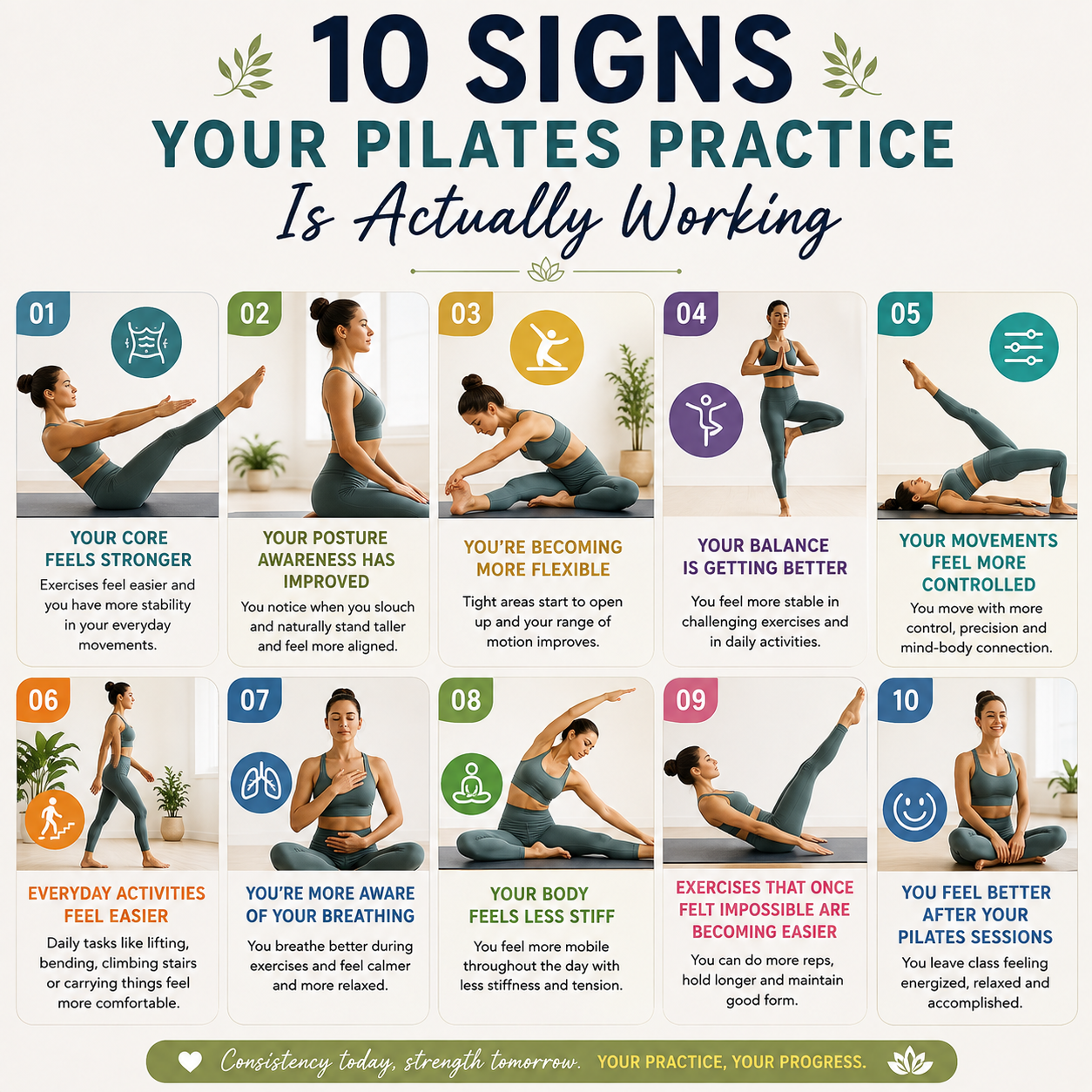
1. Your Core Feels Stronger
One of the first areas where many people notice progress is the core.
Pilates places significant emphasis on controlled movement and trunk stability. As you practice consistently, exercises that initially felt extremely difficult may gradually become more manageable.
You may notice that you can hold positions longer, control your movements better, or complete exercises without losing your form as quickly.
Core strength can also show up outside the studio.
Standing for longer periods, getting out of bed, carrying everyday items, or maintaining your position while exercising may begin to feel easier.
The change may not immediately give you visible abdominal muscles, but feeling more stable and supported through your center is an important sign of progress.
2. Your Posture Awareness Has Improved
Have you suddenly started noticing when you’re slouching?
That’s progress too.
Pilates encourages awareness of your spine, pelvis, shoulders, rib cage, and head position.
After practicing regularly, you may find yourself naturally checking your posture while working at your desk, driving, walking, or using your phone.
This doesn’t mean you need to maintain one rigid “perfect posture” throughout the day.
Instead, Pilates can help you become more aware of your positioning and encourage you to move or adjust when your body has remained in one position for too long.
When body alignment starts becoming something you notice automatically, your Pilates training is moving beyond the studio and into everyday life.
3. You’re Becoming More Flexible
Remember when touching your toes felt impossible?
Or when certain stretches felt extremely tight?
Over time, Pilates may help improve flexibility and comfortable range of motion through controlled, repeated movement.
You might notice that:
- Your hamstrings feel less tight
- Your hips move more comfortably
- Your shoulders feel more mobile
- Bending and reaching become easier
- Certain Pilates positions feel more natural
Flexibility progress is usually gradual.
That’s why you may not notice it from one class to the next.
But compare how you move today with how you moved during your first few sessions, and the difference may become much clearer.
4. Your Balance Is Getting Better
Balance is an often-overlooked part of fitness.
Pilates regularly challenges your body to remain stable while different parts of your body are moving.
Initially, you might wobble during certain exercises or need additional support.
With consistent practice, those same movements may begin to feel more controlled.
You may also notice better balance during everyday activities, whether you’re climbing stairs, changing direction quickly, or simply standing on one leg while getting dressed.
Better balance can indicate improvements in coordination, strength, and body awareness.
5. Your Movements Feel More Controlled
Pilates isn’t about completing exercises as quickly as possible.
Control is one of its most important principles.
During your first few classes, you may find yourself rushing through movements or relying on momentum.
As your technique improves, you begin moving differently.
You become more intentional.
You know when to inhale and exhale. You understand which muscles should be working. You can slow an exercise down without losing control.
Interestingly, moving slowly can sometimes make Pilates feel even harder.
When you can perform an exercise smoothly and deliberately rather than rushing through it, that’s a major sign that your practice is improving.
6. Everyday Activities Feel Easier
Some of the best Pilates results happen outside your Pilates class.
You may suddenly notice that carrying groceries feels easier.
Perhaps climbing stairs doesn’t tire you as quickly.
You may feel more comfortable getting up from the floor, bending down, reaching overhead, or sitting for longer periods.
These changes can happen because Pilates isn’t simply training individual muscles.
It encourages your body to coordinate movement, stability, balance, and control.
Fitness should help you live your everyday life more comfortably—not just perform exercises inside a studio.
If normal activities are becoming easier, your Pilates practice may be doing exactly what it should.
7. You’re More Aware of Your Breathing
Breathing may seem simple, but Pilates makes you pay attention to it.
Beginners often unintentionally hold their breath when an exercise becomes challenging.
With practice, breathing and movement start working together more naturally.
You begin understanding when to inhale and when to exhale.
You may also notice yourself using slower, more intentional breathing when you’re stressed or need to relax.
This improved breathing awareness can make Pilates feel less like a collection of exercises and more like a connected mind-body practice.
When breathing becomes part of your movement instead of something you forget about, that’s meaningful progress.
8. Your Body Feels Less Stiff
If you spend long hours sitting at a desk, driving, or using digital devices, your body may regularly feel stiff.
Pilates introduces movement through the spine, hips, shoulders, and other joints.
After consistent practice, you may begin noticing that your body feels more mobile.
Morning stiffness may feel less noticeable.
Standing up after sitting for a long time may feel easier.
Your shoulders or hips may feel less restricted during everyday movement.
This doesn’t mean Pilates can treat every cause of stiffness or pain. Persistent or unexplained symptoms should always be assessed appropriately.
But feeling more comfortable during normal movement can be a positive sign that regular physical activity is benefiting you.
9. Exercises That Once Felt Impossible Are Becoming Easier
Think back to your first Pilates class.
Maybe your legs were shaking.
Perhaps you couldn’t maintain a position for more than a few seconds.
Maybe coordinating your arms, legs, breathing, and core felt almost impossible.
Now repeat that same exercise.
Does it feel different?
You may still find it challenging, but perhaps you can complete more repetitions while maintaining good form.
That’s progress.
One of the easiest ways to recognize Pilates improvement is to compare your current ability with your own starting point, rather than comparing yourself with someone else in the class.
Everyone progresses differently.
Your previous version is the comparison that matters most.
10. You Feel Better After Your Pilates Sessions
Not every Pilates result needs to be visible.
Sometimes the strongest sign is simply how you feel after class.
You may leave feeling:
- More energized
- Less mentally stressed
- More connected to your body
- Accomplished
- Relaxed
- More mobile
- Stronger
- More confident in your movement
Over time, Pilates may stop feeling like something you “have to do” and become something your body genuinely looks forward to.
That change in your relationship with movement is valuable.
A sustainable fitness routine isn’t only about physical transformation.
It’s also about finding movement that you enjoy enough to continue.
What If You Don’t See Visible Changes Yet?
Don’t assume Pilates isn’t working simply because you haven’t noticed dramatic physical changes.
Visible results depend on many factors, including:
- Your starting fitness level
- How frequently you practice
- Exercise intensity
- Nutrition
- Sleep
- Recovery
- Daily activity
- Genetics
- Your individual goals
Someone practicing Pilates twice per week may progress differently from someone practicing four times per week.
More importantly, improvements in strength, mobility, balance, posture awareness, and movement control can appear before major visual changes.
Give your body enough time to adapt.
How Long Does It Take to Notice Pilates Results?
There is no universal timeline.
Some beginners notice changes in body awareness, breathing, or flexibility within the first few weeks.
Strength and movement control may become more noticeable after several weeks of consistent practice.
Visible physical changes can take longer and depend heavily on your overall lifestyle.
Instead of asking:
“How quickly can Pilates change my body?”
Try asking:
“What can my body do today that it couldn’t do when I started?”
That question often gives you a much better picture of your real progress.
Don’t Chase Perfection—Build Consistency
Pilates rewards consistency.
You don’t need to perform the most advanced exercise in the room to make progress.
A well-controlled beginner exercise can be more valuable than an advanced movement performed with poor technique.
Focus on:
- Proper form
- Controlled movement
- Regular practice
- Breathing
- Gradual progression
- Appropriate recovery
Some weeks will feel stronger than others, and that’s completely normal.
Fitness progress isn’t perfectly linear.

