Maybe work became busy.
Perhaps you went on vacation, changed your routine, or simply lost motivation.
One week without Pilates becomes two weeks. Two weeks become a month, and suddenly you realize you haven’t attended a Pilates class in a long time.
Then comes the question:
“What happens to my body when I stop doing Pilates?”
First, don’t panic.
Your strength and flexibility do not disappear overnight. Taking a short break from Pilates is completely different from permanently giving up physical activity.
However, when your regular movement routine changes, your body may gradually begin to feel different.
You may notice increased stiffness, reduced flexibility, less core awareness, or movements that once felt easy becoming slightly more challenging.
The changes depend on several factors, including how long you’ve practiced Pilates, your fitness level, your daily activity, and how long your break lasts.
Let’s explore what may happen when you stop practicing Pilates and how you can safely return.
The First Week Without Pilates
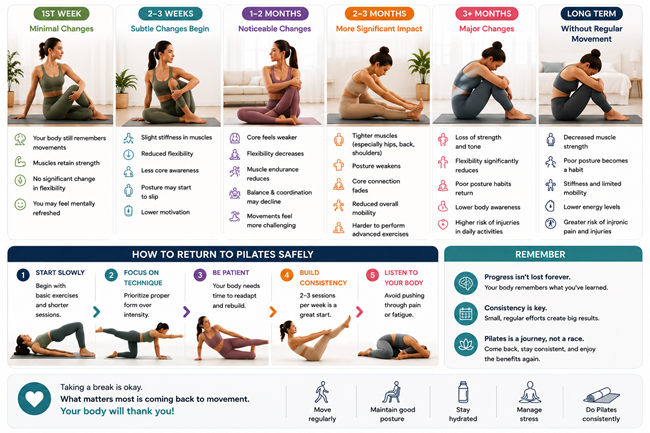
During the first few days, you may not notice significant physical changes.
If you’ve been practicing Pilates consistently, your body does not immediately forget everything it has learned.
Your muscles still retain strength, and your movement awareness remains.
In fact, a short break can sometimes provide valuable recovery, particularly after an intense training period.
You may feel rested and refreshed.
However, people who use Pilates as part of their stress-management routine may notice the mental difference sooner.
You might miss the focused breathing, controlled movement, and calm environment of your Pilates sessions.
At this stage, major physical changes are unlikely.
After Two to Three Weeks
After a few weeks without regular Pilates, subtle differences may become noticeable.
Movements that previously felt smooth may require slightly more concentration.
You may notice:
- Mild muscle stiffness
- Reduced flexibility
- Less core awareness
- Tightness after prolonged sitting
- Slightly reduced balance
- Lower exercise motivation
If you remain physically active through walking, strength training, yoga, or another form of exercise, these changes may be less noticeable.
Your overall lifestyle plays an important role.
Stopping Pilates does not mean your body suddenly becomes unhealthy.
However, removing regular movement without replacing it with another activity may gradually influence how your body feels.
After One to Two Months
After a longer break, you may notice clearer changes.
Your core muscles may not feel as responsive as they did during regular practice.
Exercises that once felt controlled may feel more challenging.
Flexibility may gradually decrease, particularly if your daily routine involves long periods of sitting.
You may also notice changes in muscular endurance.
For example, holding a Pilates position for a certain amount of time may feel more difficult when you return.
This is a normal part of detraining.
The body adapts to the demands placed upon it.
When you practice regularly, your body adapts to Pilates.
When you stop, the body gradually adjusts to your new activity level.
Your Core May Feel Less Connected
Pilates is famous for its focus on core control.
Regular practice teaches you to become aware of the muscles supporting your trunk.
Over time, engaging your core during exercises may begin to feel natural.
When you stop practicing, this awareness may become less automatic.
You haven’t necessarily “lost your core.”
Instead, the connection between attention, breathing, and muscle engagement may feel less familiar.
When returning to Pilates, many people need a few sessions to reconnect with proper core activation.
The positive news is that previous movement experience can make relearning easier.
Your Flexibility May Gradually Decrease
Flexibility is not a permanent achievement.
It responds to regular movement.
Pilates often takes the body through controlled ranges of motion, helping maintain mobility and flexibility.
When these movements disappear from your routine, certain areas may gradually feel tighter.
Common areas include:
- Hips
- Hamstrings
- Shoulders
- Upper back
- Lower back
People with desk-based lifestyles may notice stiffness sooner because their daily routine includes extended periods of sitting.
Regular movement is important for maintaining comfortable mobility.
You May Notice Changes in Posture Awareness
One of the hidden benefits of Pilates is increased body awareness.
During classes, instructors frequently guide your alignment and movement.
Over time, you may become more aware of how you sit, stand, and walk.
When you stop Pilates, daily habits can gradually take over again.
You may find yourself slouching at your desk more frequently or paying less attention to shoulder and spinal alignment.
This does not mean Pilates permanently “fixes” posture.
Instead, regular practice reminds you to notice how your body is positioned.
Without those regular reminders, posture awareness may become less automatic.
Balance and Coordination May Feel Different
Pilates often challenges balance and coordination through controlled movements.
These skills improve through practice.
After a long break, certain exercises may feel less stable when you return.
Your body may need time to become familiar with the movement patterns again.
This is particularly important to remember if you previously practiced advanced Pilates exercises.
Do not expect your body to immediately perform at exactly the same level after several months away.
Returning gradually is usually a smarter approach.
What Happens Mentally When You Stop Pilates?
The physical effects are only part of the story.
For many people, Pilates becomes a mental wellness ritual.
The class creates dedicated time to focus on breathing and movement.
When this routine disappears, some people notice they feel more mentally restless or disconnected from their body.
You may also experience frustration because you know movement makes you feel better, yet restarting feels difficult.
This is a common experience with exercise routines.
The longer the break becomes, the harder the first session can feel mentally.
The solution is not to wait for perfect motivation.
Sometimes, simply starting with a short beginner-friendly session is enough to rebuild momentum.
Will You Lose All Your Pilates Progress?
No.
A break does not automatically erase all your progress.
The amount of change depends on:
- How long you’ve practiced Pilates
- Your previous fitness level
- The length of your break
- Your age
- Your overall activity level
- Your lifestyle
- Other forms of exercise
Someone who practiced Pilates consistently for several years may respond differently from someone who attended classes for only one month.
Your previous movement experience still matters.
When you return, you may notice that certain exercises feel familiar even if your strength has temporarily decreased.
How to Return to Pilates After a Long Break
The biggest mistake is trying to restart exactly where you stopped.
If you previously attended advanced classes, you may feel tempted to immediately return to the same intensity.
Instead, give your body time to readjust.
Consider these simple steps:
Start With the Basics
Return to fundamental movements.
Focus on breathing, alignment, and controlled core engagement.
Reduce Intensity Temporarily
Choose a beginner or intermediate session based on your current ability.
Your previous level does not need to define your first session back.
Focus on Technique
Avoid rushing through exercises.
Pilates rewards control and precision.
Expect Some Muscle Soreness
Your muscles may respond differently after a break.
Allow appropriate recovery between sessions.
Build Consistency Gradually
You do not need to practice every day.
Starting with two or three regular sessions may be more sustainable than an extreme restart.
Can Taking a Break From Pilates Be Good?
Yes, sometimes.
Rest and recovery are important parts of any fitness routine.
A short planned break may help your body recover and can refresh your motivation.
The problem is not necessarily taking a break.
The challenge occurs when a temporary break turns into months of inactivity without intentional movement.
Listening to your body is important.
If you’re injured, experiencing persistent pain, pregnant, recovering from surgery, or managing a medical condition, seek appropriate professional guidance before returning to exercise.

