A Beginner’s Complete Guide | Pilates Blog
So you’ve finally signed up for your first Pilates class. Maybe a friend recommended it, maybe your physiotherapist suggested it for your back pain, or maybe you’ve just been curious about all the buzz. Whatever brought you here — welcome! Walking into any new fitness class can feel intimidating, but Pilates is one of the most welcoming, low-impact, and beginner-friendly workouts out there.
This guide will walk you through everything you need to know before your first session — from what to wear and what to bring, to what the class will actually look and feel like. By the time you finish reading, you’ll walk into that studio feeling calm, prepared, and excited.
1. First Things First — What Is Pilates?
Pilates is a low-impact exercise method developed in the early 20th century by Joseph Pilates. It focuses on controlled movements, core strength, flexibility, and body awareness. Unlike heavy weightlifting or high-intensity cardio, Pilates works through precision and breath — making it accessible to almost everyone, from complete beginners to elite athletes.
There are two main types of Pilates you might encounter: Mat Pilates (done on the floor with a mat) and Reformer Pilates (done on a spring-based machine called a Reformer). As a beginner, you’ll likely start with a Mat class, which is what most introductory sessions offer.
2. What to Wear and Bring
Comfort is key. Here’s a quick checklist:
- Form-fitting clothes — leggings and a fitted top work best. Loose clothing can get in the way of proper form corrections.
- Grip socks — most studios require these (some sell them at the front desk). They prevent slipping on the mat.
- A water bottle — you won’t be drenched in sweat like a HIIT class, but hydration still matters.
- An open mind — seriously, this is the most important thing you can bring.
Tip: Skip the heavy meal right before class. A light snack 30–45 minutes prior works best.
3. Arriving at the Studio
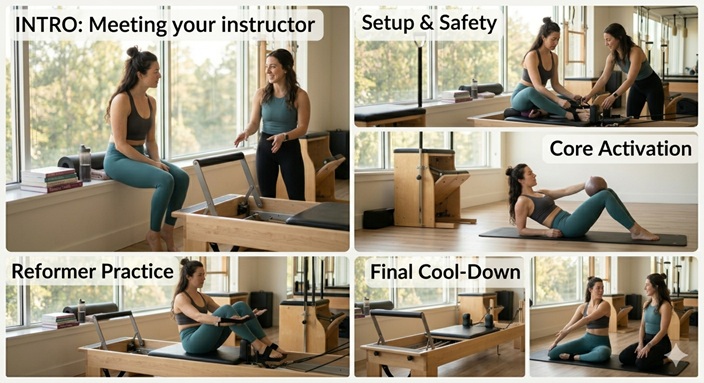
Plan to arrive at least 10–15 minutes before your class starts. This gives you time to check in, fill out any intake forms (many studios ask about injuries or health conditions), and get a quick orientation from the instructor.
Don’t hesitate to introduce yourself to the instructor and mention it’s your first class. A good Pilates teacher will make sure to keep an eye on you, offer modifications where needed, and ensure you feel comfortable throughout the session.
4. What Happens During the Class
A typical beginner Mat Pilates class runs for 45 to 60 minutes. Here’s how it usually flows:
Warm-Up (5–10 minutes)
The class typically begins with breathing exercises and gentle spinal mobilisation. You’ll be guided to connect with your breath and become aware of your posture and alignment — this is the foundation of everything in Pilates.
Core Work (20–30 minutes)
This is the heart of the class. You’ll work through a series of controlled movements targeting the core — but don’t picture crunches or sit-ups. Pilates core work includes exercises like the Hundred, leg circles, roll-ups, and the bridge. Each movement is slow and intentional, and the instructor will cue you to engage your abdominals, lengthen your spine, and stabilise your pelvis.
Strength & Flexibility Exercises (15–20 minutes)
This portion includes side-lying work for hips and glutes, seated stretches, and upper body strengthening. Many movements target postural muscles that don’t get enough attention in everyday life or other workouts.
Cool-Down & Stretch (5–10 minutes)
Classes typically end with a calming stretch sequence and often a short relaxation moment. You’ll likely leave feeling both energised and surprisingly calm — that’s the Pilates effect!
5. Things You Might Feel During Your First Class
Be honest — here’s what first-timers often experience:
- Confusion about cues — terms like ‘neutral spine’, ‘imprint’, or ‘zip up your core’ might sound strange at first. Totally normal. They’ll click within a few sessions.
- Muscles you didn’t know existed — Pilates activates deep stabilising muscles that most workouts ignore. You might feel a gentle burn in unexpected places.
- Frustration with ‘doing it right’ — Pilates has a learning curve. Focus on how it feels, not on perfection.
- Unexpected calm — the focused breathing and deliberate movement often create a meditative effect.
Mild muscle soreness the next day is completely normal, especially around the core and inner thighs. It usually fades after your second or third session as your body adapts.
6. Modifications Are Your Best Friend
One of the beautiful things about Pilates is that every exercise can be modified. If you have a bad knee, a stiff shoulder, or haven’t exercised in years — there is a version of every movement that works for your body. Never push through pain. Pilates should feel challenging, not harmful.
Your instructor is there to help. Ask questions, ask for modifications, and communicate. A great Pilates teacher will meet you exactly where you are.
7. How Many Classes Before You See Results?
Joseph Pilates famously said: “In 10 sessions you’ll feel the difference, in 20 you’ll see the difference, and in 30 you’ll have a whole new body.” While that’s a generalisation, there’s real truth in it.
Here’s a realistic timeline:
- After 3–5 sessions: Better body awareness, improved breathing, and slightly less stiffness.
- After 8–10 sessions: Noticeable improvement in posture, core engagement, and flexibility.
- After 1 month (2–3x per week): Visible toning, reduced back pain, improved balance.
Consistency matters more than intensity in Pilates. Two to three sessions a week is ideal for beginners.
8. Common Beginner Mistakes to Avoid
- Holding your breath — breathing is core to Pilates. If you catch yourself holding it, gently reset.
- Rushing through movements — slow and controlled is always better than fast and sloppy.
- Skipping the warm-up — tempting if you’re running late, but the warm-up prepares your joints and sets your form for the whole class.
- Comparing yourself to others — everyone is at a different stage. Focus on your own body.
Final Thoughts: You’ve Got This
Your first Pilates class is just the beginning of a long, rewarding journey. It’s a practice built on patience, precision, and presence. Unlike many fitness trends that chase quick results, Pilates builds something deeper — strength from the inside out, a connection between your mind and body, and a way of moving through life with more ease and confidence.
So take a deep breath, roll out your mat, and trust the process. Your body will thank you for it — probably starting right after your very first class.

